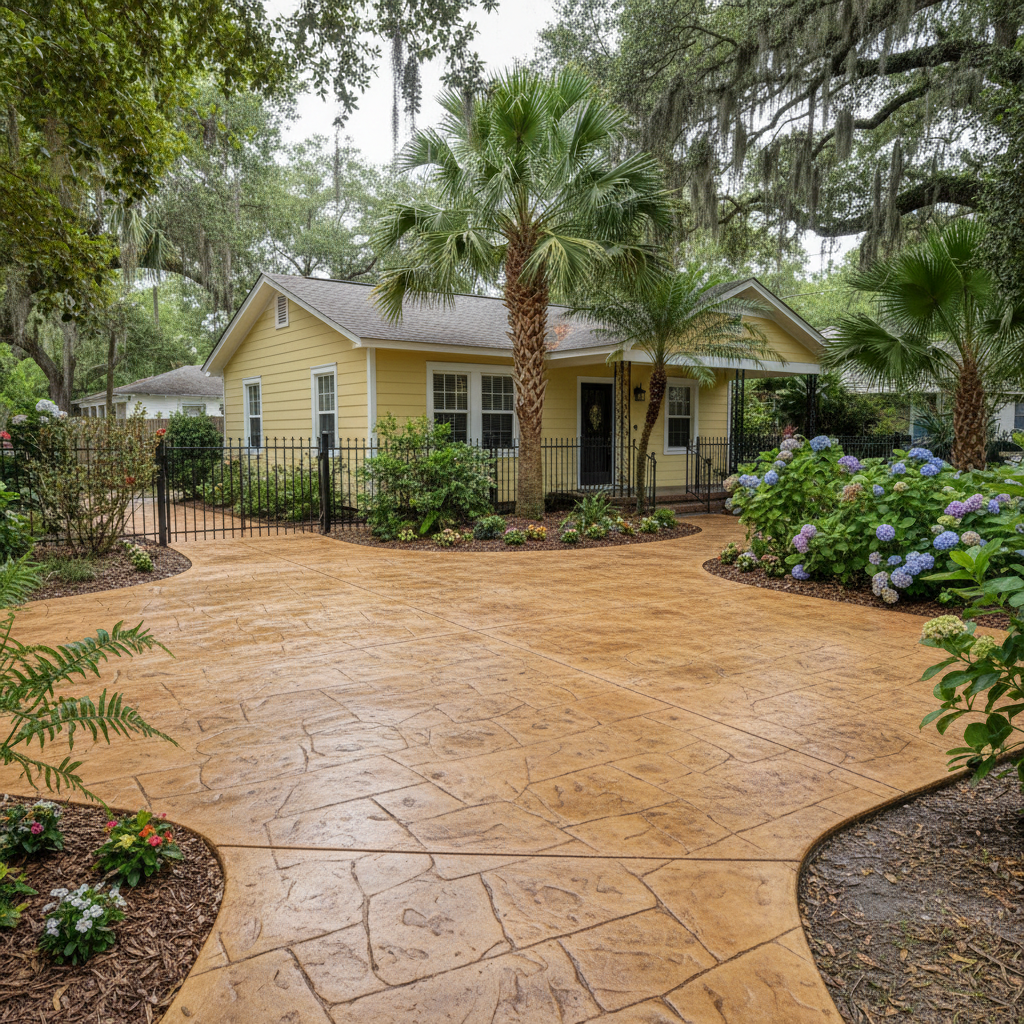
You're probably wondering what decorative concrete is going to set you back. It's not a one-size-fits-all answer, but I can give you a pretty good idea of what affects the price and what you should expect to see on a quote here in New Orleans.
What Makes Decorative Concrete Cost What It Does?
A few big things really push the price up or down. It's not just about square footage, though that's a big part of it.
- The Type of Finish: This is probably the biggest factor. A simple stained concrete floor is going to be way less than an intricate stamped patio or a polished concrete surface. Staining or acid etching might run you anywhere from $4 to $10 per square foot. Stamped concrete, which involves patterns and textures to mimic stone or brick, usually starts around $10 and can go up to $20+ per square foot, especially for complex patterns or multiple colors. Polished concrete is a whole different beast, often $8 to $18 per square foot, depending on the aggregate exposure and the level of sheen. Epoxy coatings, particularly those with metallic flakes or custom designs, can be $7 to $15 per square foot or more.
- Condition of the Existing Concrete: If you've got a perfectly smooth, uncracked slab, great! That's less prep work. But if we're dealing with a cracked, uneven, or heavily damaged slab, we've got to fix that first. Crack repair, grinding, leveling, and patching all add labor and material costs. Sometimes, if the slab is too far gone, it might even need a self-leveling overlay, which is an extra layer of concrete that can add $3 to $7 per square foot just for the material and application before any decorative work even starts.
- Job Size and Accessibility: Bigger jobs often mean a lower per-square-foot cost because we can be more efficient. A small bathroom floor might have a higher per-square-foot price than a 1,000-square-foot patio. Also, if we have to haul equipment and materials through a tight shotgun house or up three flights of stairs in the French Quarter, that's going to factor into the labor cost.
- Complexity of Design: Simple one-color applications are cheaper. If you want multiple colors, intricate patterns, custom stenciling, or hand-troweled textures, that's more labor and more specialized materials.
- Sealing and Protection: Every decorative concrete job needs a good sealer to protect it from our humid New Orleans weather, spills, and wear. High-traffic areas or outdoor applications might need more robust, commercial-grade sealers, which cost more.
Typical Price Ranges You'll See in NOLA
Alright, let's get down to some numbers. Keep in mind these are averages, and your specific project could be higher or lower depending on those factors I just mentioned.
- Basic Stained or Acid-Etched Concrete: For a simple, one-color application on a good existing slab, you're looking at roughly $4 to $10 per square foot. This is a popular choice for interior floors, giving a unique, mottled look.
- Stamped Concrete Patios/Driveways: Expect to pay $10 to $20+ per square foot. The higher end is for multi-color, complex patterns that really mimic natural stone or wood. It's a fantastic way to upgrade an outdoor space, and it holds up great to our subtropical climate.
- Polished Concrete Floors: These are usually in the $8 to $18 per square foot range. The price depends heavily on the desired aggregate exposure (how much of the stone shows through) and the level of shine. It's super durable and low maintenance.
- Epoxy Coatings (Garage Floors, Commercial Spaces): For a solid color epoxy, you might see $5 to $10 per square foot. For decorative flake systems or metallic epoxies, it's more like $7 to $15+ per square foot. These are tough and chemical-resistant, perfect for garages or commercial kitchens.
So, for a 500-square-foot patio, a basic stamped concrete job might be $5,000, while a more elaborate one could hit $10,000 or more. A 1,000-square-foot interior floor with a simple stain could be $4,000 to $10,000.
What Should Be Included in Your Quote?
When Omega Concrete Solutions gives you a quote, or any reputable contractor for that matter, it should be clear. Here's what you want to see:
- Surface Preparation: This is crucial. Grinding, cleaning, crack repair, patching, and any necessary overlays should be detailed.
- Materials: The specific type of decorative finish (stain, stamp, polish, epoxy), colors, patterns, and any additives.
- Application Labor: The cost for the crew to do the work.
- Sealing: The type of sealer, number of coats, and any anti-slip additives if needed.
- Cleanup and Disposal: What happens to the waste materials.
- Warranty: What's covered and for how long.
Make sure it's all itemized or at least clearly explained. If a quote just says